Marie Gineste
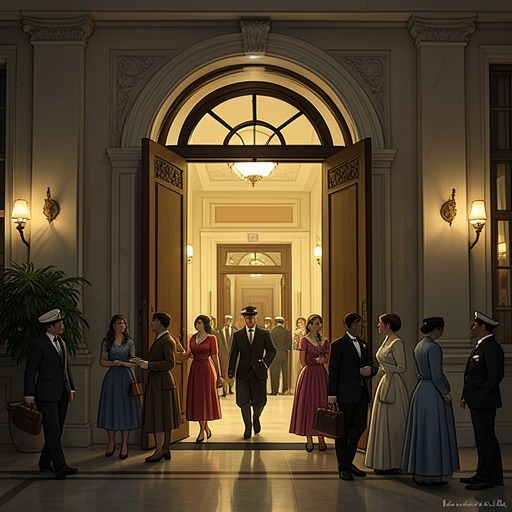
In Search of Lost TimeMarie Gineste, one of two women employed as courrières at the Grand Hotel at Balbec, becomes a friend and frequent morning visitor of the narrator. Brisk, direct, and protective of both her sister and the conventions of service, she counters Céleste Albaret’s theatrical teasing with practical admonitions. Her sharpness is more than comic opposition: the sisters’ intimacy with the narrator gives them room to observe and judge him, while their position as hotel workers exposes the social distance that their friendship crosses.
Identity and Introduction
Marie arrives in Balbec with her sister, Céleste Albaret, as a maid to an elderly foreign lady. The sisters are called courrières in hotel language, though Françoise mistakenly associates the word with running errands and calls them coursières. The narrator says that, despite the difficulty guests had in entering servants’ quarters and servants in entering guests’ rooms, he and the two women soon formed a strong and unforced friendship.
The sisters come from the mountainous centre of France, where their family home stood beside flowing water and a millwheel and had often been damaged by floods. The narrator describes their temperaments through the water of their childhood landscape: Marie is the more regularly rapid and staccato current, while Céleste is softer and more lake-like until her anger turns turbulent. This contrast gives Marie a recognizable presence within the pair: she is the quick, forceful countervoice to her sister’s languorous performance.
Friendship with the Narrator
The sisters often visit the narrator in the morning while he is still in bed. Their conversations make the private hotel room a place where the usual hierarchy between guest and servant becomes less rigid. Céleste comments freely on his appearance and habits; Marie objects that her sister is speaking improperly to Monsieur, even as she remains part of the exchange. The narrator values the sisters’ company more than that of other hotel visitors and laughs at the manager’s grave suggestion that a customer should not converse with servants.
Their friendship is marked by a double perspective. The women are familiar enough to speak to the narrator without ceremony, but their words also keep social rank in view. When Céleste calls him spendthrift for wasting a croissant because it has touched the bed and spilling his milk, Marie rebukes her for addressing him so freely. Her protest does not end the banter: Céleste carries on, likening the narrator to a snake when he springs upright, and Marie continues to object that he dislikes having a napkin tied around his neck. The scene shows the sisters’ distinct roles without reducing their closeness to a simple opposition: Marie’s indignation is part of the familiar relationship, even as it voices the rules that relationship bends.
Judgment and Character
Marie’s judgment can be as perceptive as her temper is brisk. When the narrator asks what she thinks of M. Nissim Bernard’s behaviour, she answers that she has encountered things she would not have believed could exist before coming to the hotel. She adds that one can never tell what may be in a person’s life. Her remark registers the hotel as a place where private conduct and unexpected relations become visible to staff as well as guests.
Speaking of the narrator’s father, Marie imagines a life of continuous work and self-sacrifice, with no pleasure or time kept for oneself. She then turns to the narrator’s ordinary movements, admiring the distinction with which he places a hand on the counterpane and picks up a croissant, as though the nobility of France were present in his gestures. The idealized portrait contrasts with Céleste’s teasing portrait of a clumsy, wilful young man. Marie’s praise does not establish that the narrator is in fact the noble figure she describes; instead, it reveals her ability to confer grandeur on small acts and to read character through gesture.
Narrative Role and Significance
Marie helps the novel make the hotel’s servant world socially and psychologically legible. The manager treats conversation between customer and staff as improper, while the narrator’s friendship with the sisters makes their voices central to his daily life. Their visits also invert the expected direction of observation: the narrator may be the guest, but Céleste and Marie scrutinize his eating, movements, temper, and self-presentation, and their remarks expose how differently he can be seen.
Marie’s forceful interventions also give the sisters’ dialogue its rhythm. Céleste’s elaborate, zoological comparisons and mock accusations of deceit are repeatedly met by Marie’s exasperated corrections; Marie can then shift from protest to a serious reflection on the unknowability of other people’s lives. Her character is therefore defined both by contrast with Céleste and by moments that exceed that contrast, joining comic immediacy to a sober awareness of the hidden complexity around her.